

Last updated: September 12, 2026
The average funeral cost in Canada is about $7,793, based on the Seniors Choice Cost of Dying Report. This guide also uses Statistics Canada, CANA, government data, and industry sources to compare funeral costs by province in 2026. Costs range from about $4,500 in Quebec to over $16,000 in Nunavut. A traditional burial averages $9,000–$15,000+; direct cremation is the lowest cost option at $1,500–$3,500.
Key Takeaways
- The national average funeral cost in Canada is $7,793 (Seniors Choice Cost of Dying Report 2024)
- Ontario has the highest traditional funeral costs: $9,000–$15,000+ (endoflifetools.com 2025–2026)
- Quebec has the lowest: $4,500–$8,000, partly due to funeral cooperatives reducing costs 20–40%
- 76.7% of Canadians chose cremation in 2024, up from 60.6% in 2009 (CANA 2025 Annual Statistics Report)
- The cheapest direct cremation in Canada is $845 in Vancouver (Canadian Funerals Online 2026)
- 46% of Canadians believe they cannot afford a funeral (Seniors Choice Cost of Dying Report 2024)
- The CPP Death Benefit has a basic amount of $2,500. That is less than a third of the national average funeral cost. For deaths on or after January 1, 2025, it may include an additional $2,500. The maximum is $5,000. The CPP coverage comparisons in this report use the basic amount.
- Canada’s funeral industry generates $1.6 billion in annual revenue across 2,598 businesses (IBISWorld 2025)
- 326,779 Canadians died in 2024, slightly down 0.2% from 2023 (Statistics Canada, Deaths 2024)
- 7.6 million Canadians are 65+; by 2030 seniors will represent 21.4–23.4% of the population (Statistics Canada)
- Natural burial cemeteries tripled in Canada since 2018 (Natural Burial Association)
- In one illustration, a Toronto burial is about $24,200 using York Cemetery’s published charges, the lowest complete cemetery-billed stack among the Toronto cemeteries in this dataset, plus national average service, casket, and monument costs. York’s cemetery charges are before HST; the source does not state the tax basis of the national averages. Published monument lot prices in the dataset run from $4,115 at Resurrection in Whitby to $94,689 at Mount Pleasant.
This national guide is designed for Canadians comparing funeral costs by province. For a local Ontario and GTA breakdown, read our guide to average funeral costs in Ontario and Toronto.
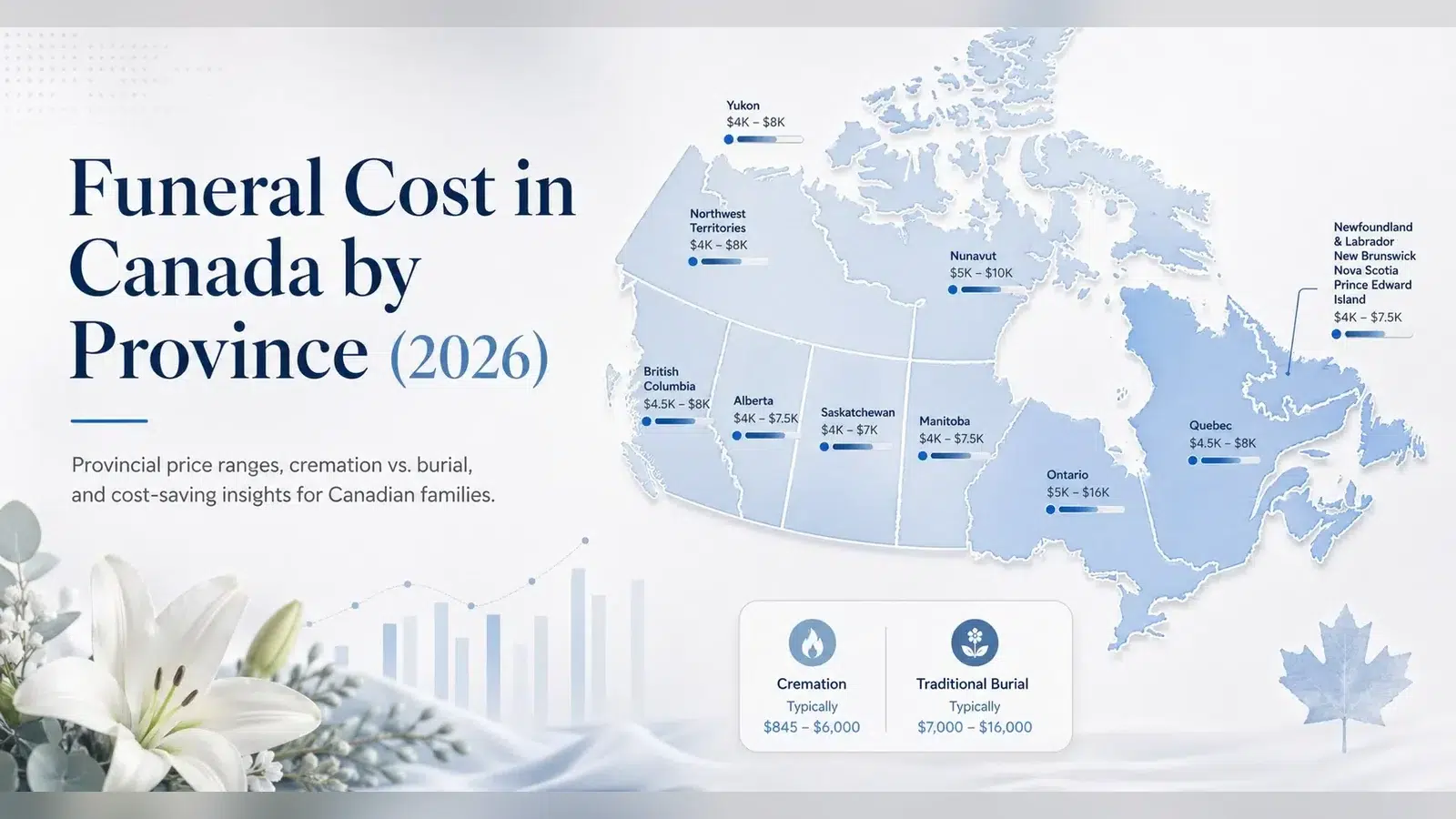
Average Funeral Cost in Canada by Province
Ontario charges roughly double what Quebec does for the same service type. The gap reflects real structural differences: land values that push cemetery prices into five figures in the GTA, provincial regulations that vary in pricing transparency requirements, and operating costs that track with urban wage pressure. Nunavut sits at the other extreme for entirely different reasons: remoteness and infrastructure constraints push costs to $9,000–$16,000+, matching BC for the most expensive jurisdiction despite having the smallest population.
Provincial cost ranges
Traditional funeral costs vary by more than $10,000 across Canada
Ranges are shown from $0 to $16,000. Higher cost provinces and territories are driven by cemetery land prices, transportation, and local provider availability.
Sources: endoflifetools.com 2025–2026 compiled guide; funeralhomesnearby.com provincial data; provincial funeral associations. These are compiled industry ranges, not single-survey averages.
For families in Ontario, the best way to understand the real cost is to separate funeral home fees, casket or urn selection, cemetery charges, transportation, documents, and optional services. Costs can change significantly between the GTA, smaller cities, and rural communities. To get a clearer Toronto specific estimate, use Haven Casket’s funeral cost estimator to compare common funeral and burial expenses before making arrangements.
Burial vs. Cremation: Costs and Choice
Canada’s cremation rate reached 76.7% in 2024, up from 60.6% in 2009, a 16-point shift in 15 years (CANA 2025 Annual Statistics Report). Four Canadian provinces already exceed an 80% cremation rate (CANA, most recent available 2022–2023 data). The price gap explains most of it: a direct cremation in Vancouver costs $845, while a comparable burial in the same city runs $10,000–$16,000. A $9,000+ difference per death is not a preference signal, it’s an economic one. The city level pricing below comes from named providers and is among the most granular publicly available Canadian data.
Direct cremation pricing
Lowest direct cremation cost by major Canadian city
One major city is shown for each province, based on the lowest public direct cremation figure found during review. Scale shown from $0 to $2,500.
Sources: Canadian Funerals Online 2025–2026 city/provider listings and funeral planning guides; FuneralHomesNearby provincial and city cremation cost pages. Figures reflect the lowest publicly listed direct cremation price or lowest compiled city estimate found during review and may exclude optional fees, taxes, death certificates, or mileage. *PEI note: the PEI entry is based on a province guide indicating that basic/direct cremation may be available for less than $1,000; public PEI pricing sources vary, so this should be treated as a guide estimate rather than a named-provider Charlottetown quote.
The affordability difference becomes even clearer when the service types are separated. “Cremation” is not one single product. A direct cremation is the lowest cost option because it removes the viewing, embalming, formal ceremony, reception, and many merchandise costs from the arrangement. Families can still hold a private memorial later, but they are not paying funeral home facility fees or full service staffing charges upfront.
By contrast, burial almost always carries fixed third party costs that are difficult to avoid. Even a simplified direct burial may require a cemetery plot, opening and closing fees, a burial container, transportation, and sometimes a grave liner or vault depending on cemetery rules. A traditional burial funeral adds the full ceremony layer on top of those cemetery costs: cemetery plots, visitation, embalming, professional services, casket, hearse, flowers, clergy or celebrant fees, and reception costs.
This is why the gap between cremation and burial is wider than the headline numbers suggest. Direct cremation can often be arranged for under $2,500 in many Canadian cities, while traditional burial routinely reaches five figures once cemetery and merchandise costs are included. For families comparing options under time pressure, the key question is not simply “burial or cremation?” but “how much service, ceremony, and cemetery expense do we want included in the arrangement?”
Aquamation, also called water cremation or alkaline hydrolysis, sits between these categories. It is usually more expensive than direct flame cremation but less expensive than many full service funeral or burial arrangements. Availability remains uneven across Canada, but in provinces where it is offered, it gives families another lower impact alternative that avoids many of the cemetery costs attached to burial.
Disposition cost comparison
Direct cremation vs. burial and other funeral options in Canada
National cost ranges shown from $0 to $16,000. Lower cost direct cremation and aquamation options sit well below the upper range of traditional burial and full service funeral packages.
Source note: National compiled ranges provided for editorial comparison. Actual pricing varies by province, provider, transportation, permits, cemetery charges, and optional services.
What Drives the Bill: Itemized Cost Breakdown
The average funeral director fee in Canada is now $2,741, a 27% jump from $2,163 the prior year (Seniors Choice Cost of Dying Report 2024). That single line item is just the starting point. Cemetery costs in major urban centres can
match or exceed everything else combined. Add it all up in Toronto. Professional fees, a casket, a lot that takes a monument, and the headstone come to about $24,200 in one illustration built on York Cemetery’s published charges, and reach about $106,000 in a selected high end Mount Pleasant example. Cemetery charges in both illustrations are before HST; the source does not state the tax basis of the national averages.
Itemized funeral costs
What drives the funeral bill in Canada
Funeral costs are rarely one single fee. Professional services, merchandise, cemetery charges, transportation, documents, and ceremony-related costs can each add hundreds or thousands of dollars to the final bill. Scale shown from $0 to $20,000.
Sources: Seniors Choice Cost of Dying Report 2024 for national averages for funeral director fee, casket, headstone, and limousine service; funeralhomesnearby.com; endoflifetools.com 2025–2026. Ranges are directional and actual pricing varies by province, provider, cemetery, merchandise selection, and optional services.
The 27% increase in funeral director fees reflects rising wage and operating pressures, especially in urban markets. One practical way families can reduce the final bill is by purchasing their own casket or monument directly through Haven Casket & Monument rather than relying only on funeral home merchandise. In Ontario, a funeral home cannot charge you an extra fee for a casket you did not buy from them. Haven Casket & Monument offers caskets and monuments with transparent online pricing, giving families a clearer way to compare costs before committing to a funeral arrangement.
The Affordability Gap and Government Benefits
46% of Canadians believe they cannot afford a funeral (Seniors Choice Cost of Dying Report 2024). The federal government’s primary response, the CPP Death Benefit, pays a basic $2,500. For deaths on or after January 1, 2025, it may include an additional $2,500. Against the national average of $7,793, the basic amount covers 32 cents on the dollar. Against an illustrative Toronto burial of about $24,200, it covers about 10 cents. Against a roughly $106,000 high end Mount Pleasant example, it covers under 3 cents. Cemetery charges in both illustrations are before HST; the source does not state the tax basis of the national averages. The Funeral Service Association of Canada has called on Ottawa to increase the benefit, citing Statistics Canada data showing over 10% of Canadian seniors live at or below the poverty line (Benefits and Pensions Monitor 2024). The CPP Death Benefit has not kept pace with funeral cost inflation in decades.
Affordability gap
How much the $2,500 CPP Death Benefit covers
Canada’s CPP Death Benefit starts at a basic $2,500, and the chart below uses that amount. It can cover more than half of a lower cost Quebec funeral, but only a small share of an illustrative Toronto burial once cemetery, merchandise, and service costs are included. When the deceased meets the conditions for the additional amount, the total benefit can be as much as $5,000.
Sources: Government of Canada CPP Death Benefit; Seniors Choice Cost of Dying Report 2024; endoflifetools.com 2025–2026. Coverage percentages are calculated against the listed funeral-cost examples.
36% of funerals in Canada are paid for through an insurance policy, and among those families, 81% said they were able to afford the send off their loved one wanted. Pre-planning offers a similar advantage by helping families make decisions in advance and protect against future cost increases as funeral prices continue to rise by an estimated 2–3% per year. Haven Casket and Monument’s pre-planning service gives families a transparent way to plan ahead, with funds held in trust until needed and no sales pressure or hidden markups.
Canada’s Funeral Industry: Size and Structure
Canada’s funeral sector generates $1.6 billion in annual revenue but has contracted at a 2.2% compound annual rate from 2020 to 2025 (IBISWorld Canada Funeral Homes Industry 2025), even while annual death volumes held near 327,000. The contradiction resolves quickly: cremation services generate far less revenue per transaction than traditional burials, compressing margins across the industry. The sector is heavily small business dominated, 38.3% of employer establishments have just 1–4 employees, and only 8 firms nationally qualify as medium or large.
Funeral industry structure
Canada’s funeral industry by the numbers
Canada’s funeral sector generates significant annual revenue, but the market remains heavily small-business dominated. Most employer establishments have fewer than 100 employees, with only a tiny share classified as medium or large firms.
| Metric | Value | Source |
|---|---|---|
| Total industry revenue (2025) | $1.6 billion | IBISWorld Canada Funeral Homes 2025 |
| Revenue CAGR 2020–2025 | −2.2% | IBISWorld Canada 2025 |
| Total funeral businesses in Canada | 2,598 | IBISWorld Canada 2025 |
| Employer establishments | 1,370 | ISED Statistics Canada tabulation 2025 |
| Micro businesses (1–4 employees) | 38.3% of employers | ISED 2025 |
| Small businesses (5–99 employees) | 61.1% of employers | ISED 2025 |
| Medium + large businesses (100+ employees) | 0.6% combined | ISED 2025 |
| Ontario — employer establishments | 491 | ISED 2025 |
| Quebec — employer establishments | 289 | ISED 2025 |
| British Columbia — employer establishments | 128 | ISED 2025 |
| Alberta — employer establishments | 108 | ISED 2025 |
| Nova Scotia — employer establishments | 84 | ISED 2025 |
Sources: IBISWorld Canada Funeral Homes Industry Analysis 2025; ISED Innovation, Science and Economic Development Canada — Funeral Services (NAICS 8122), Statistics Canada special tabulation 2025.
Alternative Dispositions: Aquamation, Green Burial, and Cooperatives
Natural burial cemeteries have tripled in Canada since 2018 (Natural Burial Association). Land scarcity in urban centres is as much a driver as environmental values. Mount Pleasant Cemetery in Toronto publishes adult graves at $41,917–$80,761.20 and lots that take an upright monument at $46,593–$94,689. Against numbers like those, a green burial at $1,500–$5,000 becomes financially rational no matter how the buyer feels about the environment. The fastest growing segment within alternatives is pre-planned green services, which now account for 38.7% of
the green funeral market (Emergen Research, Green Funerals Market 2024). Quebec’s cooperative funeral network is in a category of its own. Funeral cooperatives reduce costs an estimated 20–40% compared to private funeral homes by returning surplus revenue to members (Quebec Funeral Cooperatives Network,
cited in endoflifetools.com 2025–2026). No equivalent model operates at scale elsewhere in Canada.
Alternative dispositions
Alternative funeral options can significantly reduce total costs
Direct cremation, green burial, and aquamation generally sit below the upper cost range of traditional burial. Scale shown from $0 to $16,000.
Sources: Canadian Funerals Online 2026; funeralhomesnearby.com; Emergen Research Green Funerals Market 2024. Ranges are compiled national estimates and actual costs vary by province, provider, cemetery requirements, and optional services.
Find a natural burial ground by province: Green Burial Society of Canada maintains a national directory.
Future Outlook: Aging Population and Cost Trends
7.6 million Canadians are currently 65 or older, 18.9% of the total population (Statistics Canada, Older Adults and Population Aging, July 2023). By 2030, that share rises to 21.4–23.4% as the last of the baby boom cohort crosses 65
(Statistics Canada Population Projections 2023–2073). Annual death volumes, already 326,779 in 2024, will climb materially over the next decade, driving sustained demand for funeral services even as per transaction revenue
continues to compress due to the cremation shift.
Cost inflation compounds the demand increase. At the projected 2–3% annual rate, a traditional funeral costing $9,000 today reaches approximately $10,800 by 2031.
Demographic and market outlook
The forces shaping funeral demand in Canada
Aging demographics, high cremation adoption, rising annual deaths, and steady funeral cost inflation continue to shape how Canadian families plan and pay for end-of-life arrangements.
Sources: Statistics Canada Population Projections for Canada, Provinces and Territories, 2023 to 2073; Statistics Canada, The Daily — Deaths, 2024; CANA Annual Statistics Report 2024/2025; endoflifetools.com 2025–2026.
These trends point to a funeral market that will be larger in volume but more price sensitive in practice. More Canadians will need end of life services over the next decade, but a growing share of families will continue choosing cremation, simplified services, and pre-planned arrangements to keep costs manageable.
For families, the takeaway is simple: waiting usually makes funeral planning more expensive. A 2–3% annual increase may sound modest, but over several years it can add thousands of dollars to a burial, cemetery, monument, or full service funeral arrangement. Planning ahead gives families more time to compare service types, document preferences, and avoid rushed decisions during an already difficult moment.
This is especially important in high cost markets such as the GTA, where cemetery land, professional fees, and merchandise markups can quickly push a traditional burial well above the national average. Haven Casket and Monument’s pre-planning service helps families review casket, urn, monument, and arrangement options in advance, with transparent pricing and funds held in trust until needed.
Methodology and Sources
This article aggregates data from government databases, nationally representative surveys, and verified industry association reports. Provincial cost ranges are compiled from industry sources, not a single dedicated provincial
survey, and should be treated as directional ranges rather than precise averages. The Seniors Choice Cost of Dying Report 2024 is the most recent nationally representative survey of Canadian funeral costs.
Primary Sources
- Statistics Canada, The Daily, Deaths, 2024 (January 2026): total deaths, life expectancy, causes of death
- Statistics Canada, The Daily, Deaths, 2023 (December 2024): total deaths, year over year comparison
- Statistics Canada, Population Projections for Canada, Provinces and Territories, 2023 to 2073 (June 2024): seniors share and 2030 projections
- Statistics Canada / ISED, Funeral Services (NAICS 8122), special tabulation 2025: employer establishments by province, business size breakdown
- Cremation Association of North America (CANA), Annual Statistics Report 2024/2025: cremation rates, provincial thresholds, projections to 2029
- Seniors Choice Cost of Dying Report 2024: national average, itemized component averages, affordability survey data, payment methods
- IBISWorld Canada Funeral Homes Industry Analysis 2025: revenue, business count, CAGR
- Canadian Funerals Online, Cremation Costs in Canada 2026: city level direct cremation pricing by named provider
- funeralhomesnearby.com, Funeral Costs in Canada by Province and Territory: compiled provincial ranges sourced from provincial funeral associations
- Government of Canada, CPP Death Benefit: benefit amount
- Government of Newfoundland and Labrador, Funeral Assistance Benefit (July 2024): $5,000 + $1,500
- Last Post Fund: veteran burial and cremation benefit schedules
- Natural Burial Association: green burial cemetery growth since 2018
- Emergen Research, Green Funerals Market 2024: pre-planned green services market share
- endoflifetools.com, Average Funeral Cost Canada 2025–2026 Guide: provincial table, inflation projections