

Last updated: September 9, 2026
Ordering a Chinese headstone means making a run of decisions that most families only make once. What the cemetery allows. Which characters to use. What happens when one spouse is still living. This guide walks through those decisions in the order they come up, based on the monuments we make for families across the GTA. We also keep a monument designer in house who reads both traditional and simplified Chinese. Every Chinese inscription is proofread before it is cut.
It is not a guide to what your family’s traditions mean. You know those better than we do. It is a guide to what can be cut into granite, what the cemetery allows, and what to check before the stone is sandblasted.
At a glance
- Cemetery first. Most newer GTA cemeteries have Chinese sections. Their rules decide your shape and size.
- Characters. Most families who come to us ask for traditional characters. We confirm every character with the family.
- A living spouse. Some families leave that name off for now. Others have it cut and cover it with red tape.
- Adding the second name later is done at the cemetery. Approval takes 2 to 4 weeks, and most jobs finish in 4 to 8 weeks.
- Proofing. A wrong character cannot be sanded out. Check the proof closely before you approve it.
Start with the cemetery section
The cemetery decides more about your monument than any catalogue does. Most of the newer cemeteries across the GTA now have Chinese sections. Some of those sections are built with traditional Chinese architecture around them. Some start their lot numbers with 8, a number many Chinese families consider lucky.
What matters for the stone is the section rules. Each cemetery sets its own limits on height, width, granite colour, and whether a section takes upright monuments or flat markers only. A design the cemetery cannot accept means a redesign and a delay. Ask the cemetery before you choose anything.
If your section allows only flat markers, that does not rule out Chinese lettering or carved artwork. See our flat markers, bevel and slant markers and bronze markers for the formats those sections permit.
Choosing the stone
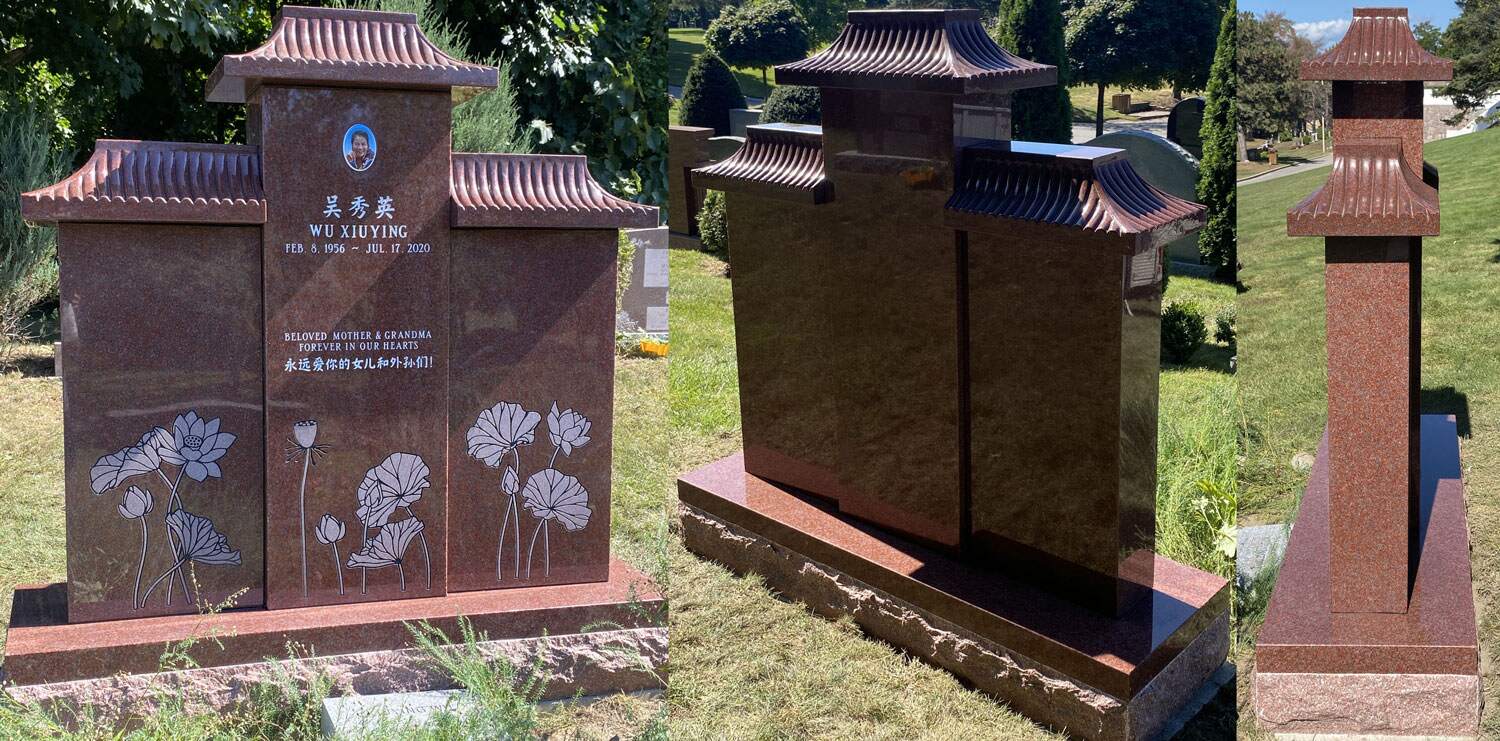
Most Chinese headstones we craft are upright monuments, where the section allows them. The pagoda top is one of the shapes we are asked for. It is a monument design drawn from Chinese architecture. Our guide to headstone types shows pagoda, wing and the other shapes side by side.


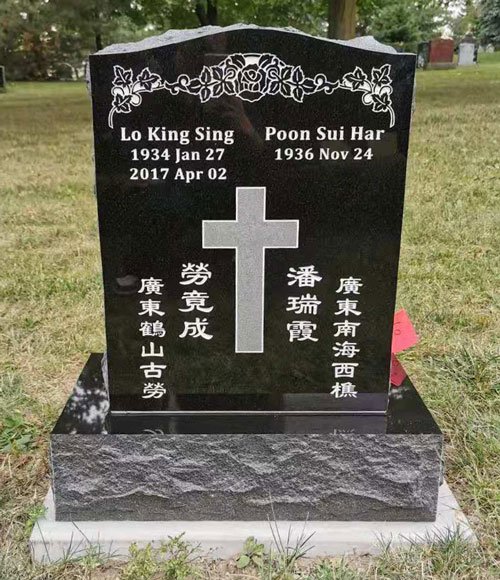

Granite colour is a family choice. Indian Red and black are the two we use most often for Chinese monuments. Our guide to granite headstone colours shows the full range.
Roof designs
A carved granite roof is one of the choices to make on a Chinese monument. It is a monument design drawn from Chinese architecture. The pagoda top named earlier on this page is one of these roofs, not a separate design. The names below are plain descriptions of what you will see rather than formal terms, because monument makers and cemeteries use different ones.
- Shaped cap. No roof. A cap slab finishes the top of the stone and keeps the monument lower, which helps in sections with tight height limits.
- Roof on the tablet. The roof sits directly on the center tablet. The ridge can run straight across, or rise to a peak finished with a ball on top and scroll ornaments at the corners.
- Roof on columns. The roof stands clear of the tablet on carved columns. For the same tablet, this stands taller than a roof that sits on the stone.
Surface work is a separate choice. Carved tile courses, an ornamental crest and figures along the ridge can be cut on either of the two roofs above.
One thing worth settling before you call. If you use the word pagoda, say whether you mean a roof on the tablet or a roof on columns. That is the difference that changes the design.


A roof can add to the finished height, so weigh it against the section’s height limit early. A lower top gives you more room to work with, but confirm the finished height with the cemetery before the design is settled.
End post finials, guardian lions, vases and an incense burner can be added to a roofed design. Ask for them in the same granite if you want them to match the monument.
Wing monuments
If a wing design is on your list, settle the width first. The wings carry the stone out on both sides, and the cemetery section sets the limit. Measure the lot and confirm the maximum width with the cemetery before the design goes far, because a design the section cannot take has to be redrawn. Our guide to headstone types shows the wing form beside pagoda tops and flat markers.
Most of the carved artwork sits on the wings, so the center panel stays clear for names and dates. Bamboo, pine, a phoenix, a dragon, or a line of verse can run down each outer edge. If you are considering a dragon and a phoenix together, ask your family what they want that pairing to say before it is settled.
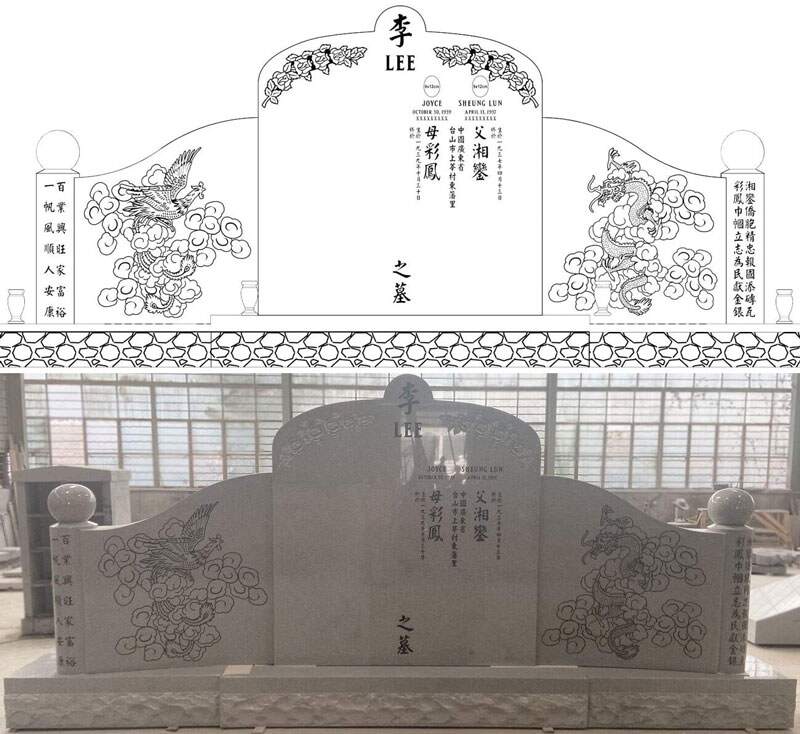
See custom monuments for the full range and current pricing.
Traditional or simplified characters
Most families who come to us ask for traditional characters. That is what we see in our shop, not a rule about what any family should choose. Chinese families in Canada come from many places and read different scripts, and the choice usually follows where the family is from.
Neither script is more correct than the other. What matters is that the stone matches what the family reads and what appears in their records. One thing worth checking early: the name on the death certificate may not match the characters the family uses. Sort that out before the design is finalised, not after.
We do not write or translate inscriptions. Wording is for your family, your elders or your temple to settle. We engrave what you approve. For help with what to put on the stone, see our guide on what to write on a headstone. We cover the character work itself in our urn engraving guide, where about half the work we do is in traditional Chinese.
When one spouse is still living
This question comes up often, and families handle it in two ways.
Some choose not to inscribe the living partner’s name at all. The stone carries one name for now, with space left for the second. Others have both names cut at the same time, then cover the living partner’s name with red tape until the time comes.
We see both. Which one suits your family is worth discussing with the people who will visit the grave.
Either way the second name is added later without moving the monument. We send a sandblaster out to engrave it at the cemetery. The cemetery has to approve the work first, which takes 2 to 4 weeks at most GTA offices. Most jobs finish in 4 to 8 weeks. Our on site monument engraving page sets out how it is done.
How the inscription is laid out
A traditional Chinese memorial inscription is usually laid out in vertical columns. The writing in the middle column tends to be the largest. Singapore’s National Heritage Board records that the characters on Chinese tombstones are intended to be read vertically downwards and right to left, following the format of traditional Chinese texts. A guide to reading engravings on Chinese tombstones notes that a stone usually carries at least three columns. It adds that on stones found overseas the usual side placement is not always followed. That pattern puts birth information on the right and death information on the left. The middle column is still kept for the name. Treat it as a common starting point, not a rule.
Families vary from there. The ancestral place of origin may be inscribed, ordered from the largest unit down to the town or village. Generation names may be carved. Married women’s inscriptions have their own conventions, and families differ on whether to follow them. Some families keep the Chinese name order on the Chinese lines and use Western order on the English line.
Most of the Chinese monuments we craft carry both Chinese and English. How the two sets of names and dates sit together is the question families ask us most. Both have to be planned together from the start so neither reads like an afterthought. For help deciding the wording itself, including how dates are handled, see our guide on what to write on a headstone.

Carved artwork
Bamboo, lotus, pine and plum are the carvings we are asked for most. Bamboo borders run up the sides of a stone. A lotus works well where the stone has a wide clear panel. These carry meaning for many families, and several belong to established sets rather than standing alone.


Dragon and phoenix panels are a design we craft often, usually as a matched pair on a companion monument. The pairing carries a strong marital association. The National Museum of Singapore holds an early twentieth century wedding garment where the two together stand for a couple and a happy marriage. That is worth knowing when you choose it for a companion stone.
We do not assign fixed meanings to artwork. A family may choose a carving because of what it represents, or simply because the person loved it. Our guide to monument engraving methods explains how each of these is cut, from sandblasting to full relief carving.
Check the proof before it is cut
Sandblasted granite is permanent. A wrong character cannot be sanded out. This is the step families should slow down on.
Every Chinese inscription is proofread in house
We keep a monument designer in house who reads and sets both traditional and simplified Chinese. Every Chinese inscription is proofread by someone who reads the language. That happens before anything reaches the stone. They set the layout, size the characters so they cut cleanly, and raise anything that looks wrong.
Every monument we design goes out as a proof first, showing the exact characters, their placement and their size.
We still ask the family to approve the proof. Have someone who reads the script look at it closely, and check these in particular:
- Character variants. The same name can be written more than one way. Confirm the form your family uses.
- Compound surnames. A two character surname must not be split as though it were a surname and a given name.
- Name order. Check the English line has not reversed the family name and given name.
- Dates. If the stone carries both calendars, check both.
- Spacing. Dense characters need room. Very small text does not sandblast cleanly.


Working with us
Our showroom is in Markham and we serve families across the GTA. Monuments are factory direct. We sell straight to the public, so there is no cemetery markup in the price. Design consultation is free.
Chinese practice is not one tradition, and families from different regions differ in wording and honorifics. We also make Vietnamese, Korean and Japanese memorials. We ask rather than assume, so bring us what your family wants and we will tell you honestly what we can do.
You can start a design yourself with our monument designer, or see finished work on our custom monuments page. For pricing, our monument cost guide for Ontario sets out the ranges.
Frequently asked questions
Do you engrave headstones in Chinese?
Yes. We engrave both traditional and simplified characters. Most families who come to us ask for traditional. We keep a monument designer in house who reads both, and every Chinese inscription is proofread before it is cut.
What happens if one spouse is still living?
Families handle it two ways. Some leave the living partner’s name off the stone for now. Others have both names cut and cover the living partner’s name with red tape until the time comes.
How long does it take to add the second name later?
We send a sandblaster to the cemetery and engrave the name on site, so the monument does not have to be moved. Cemetery approval takes 2 to 4 weeks, and most jobs finish in 4 to 8 weeks.
Do GTA cemeteries have Chinese sections?
Most of the newer cemeteries do. Some are built with traditional Chinese architecture in the section, and some start their lot numbers with 8. Each cemetery sets its own rules on stone height, colour and format, so confirm those before choosing a design.
Does a Chinese monument need a roof?
No. A roof is one design choice among several. You can have a roof on columns, a roof on the tablet, or a shaped cap with no roof at all. The cemetery section’s height limit can shape the choice.
Can you help write the inscription?
We do not write, translate or correct wording. That belongs with your family, your elders or your temple. What we do handle is the rest: laying the text out on the stone, sizing the characters so they cut cleanly, proofing what you give us, and sandblasting the text you approve.