

Last updated: August 31, 2026
When people ask about headstone types, they usually mean the shape of the stone: the top edge, the overall silhouette, the carved figures and the marker format. This guide walks through the main shapes we design and engrave, with real examples from our own work, so you can picture what suits your family. It also covers the step families miss most often: the cemetery usually decides which shapes and sizes are allowed before you choose anything.
At a glance
- Top shapes: serpentine, half ogee, flat, oval, apex and flame.
- Custom silhouettes: heart, cross, book and teardrop shapes, cut to order.
- Angel and statue monuments: carved angels and full statues that form the memorial itself.
- Carved flowers such as roses and lilies, shape carved or cut in full relief.
- Pagoda and Asian style monuments for Chinese and other East Asian traditions.
- Companion and family monuments for more than one person.
- First step: confirm what your cemetery allows before you choose a shape.
Top shapes of an upright headstone
An upright headstone (also called a monument or standing marker) has two parts: the die, the vertical tablet that carries the engraving, and the base it sits on. The shape of the top edge is the first thing most people picture, and it sets the whole tone of the memorial.


- Serpentine. A soft S-curve across the top edge. A traditional top shape that feels distinctive without being plain.
- Half ogee (Half OG). A single sweeping S-curve on one shoulder, a little more modern than a full serpentine.
- Flat and oval. A straight, clean top reads modern; a smooth oval or camber top feels balanced and gentle.
- Apex and peaked. Shaped shoulders that rise to a point, a more formal, upright look.
- Flame and irregular. A natural, one sided or rough cut edge for a softer, less formal shape.
The colour of the granite changes the character of every shape above. If you are weighing colours, our guide to granite headstone colours shows the full range side by side. To see a serpentine top set against a fully custom shape, read our serpentine and custom headstone comparison.
Heart shaped monuments
The heart is one of the most requested custom shapes, cut as a single heart for one person or a double heart for a couple.


Hearts pair naturally with carved roses or an angel, and they can be set upright or on a slant base. For couples, a double heart carries two names side by side. Our heart shaped headstones page covers the styles, cemetery rules and pricing in full.
Cross shaped monuments
A cross can be carved onto the face of a stone, or the whole stone can be cut into the form of a cross. We shape several traditions of cross.


- Cross shaped stone. The whole monument cut in the form of a cross, a strong statement of faith.
- Celtic cross. A cross with a ring around the intersection and the arms reaching beyond it.
- Orthodox crosses. The three bar cross, used in Russian, Ukrainian and Serbian Orthodox traditions.
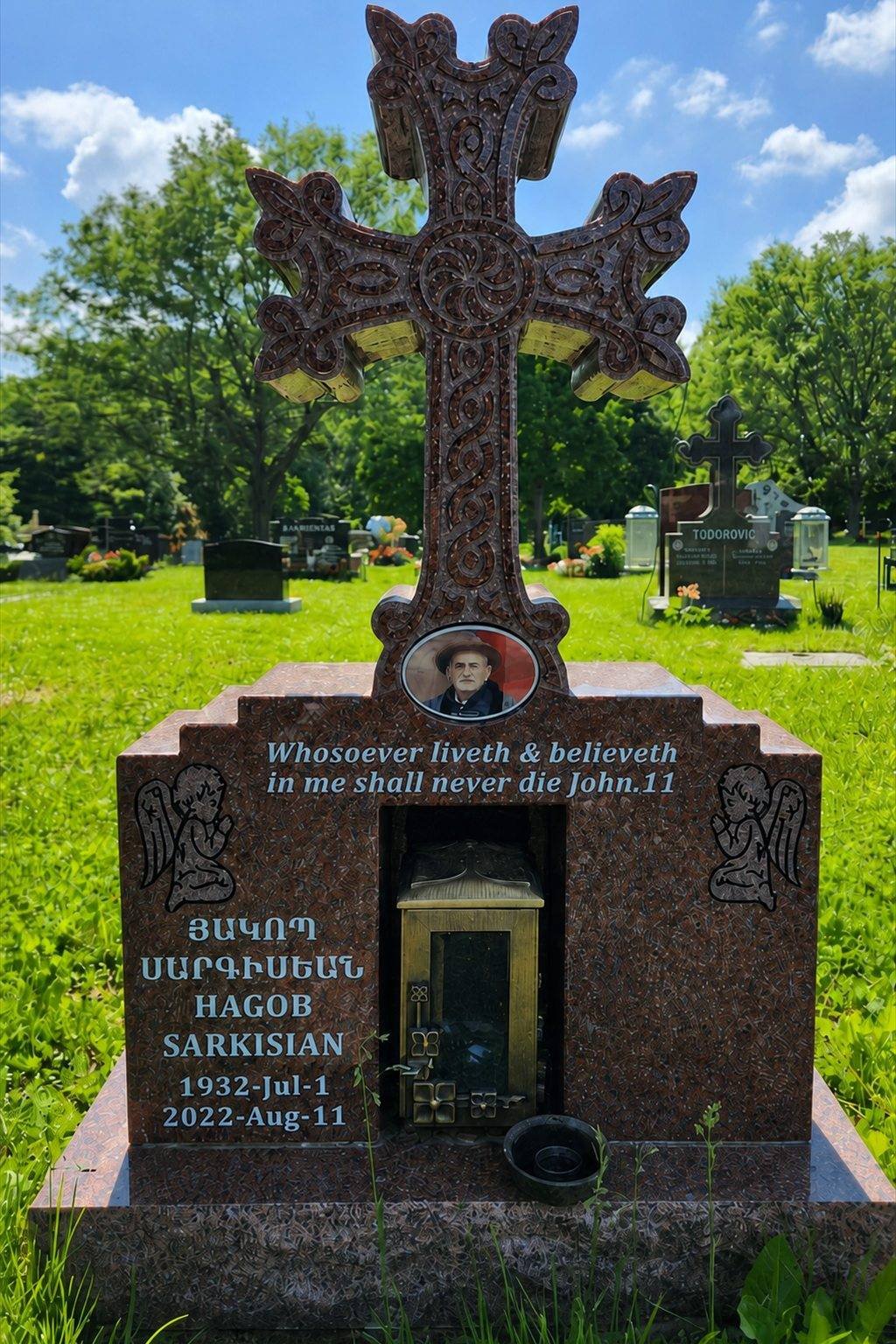
- Armenian crosses. The khachkar is a carved Armenian cross stone from the separate Armenian Apostolic tradition, cut with geometric and plant motifs.
Our cross headstones page covers the styles, cemetery rules and pricing in full.
Book monuments
A book shape suits a longer inscription or a passage of scripture. It can be carved as an open book across a slant base, or as a closed, standing book.


Angel monuments
The angel is the most requested carved figure, and one of the most detailed pieces we design. An angel can hold a heart, kneel in prayer, or spread its wings around the die.

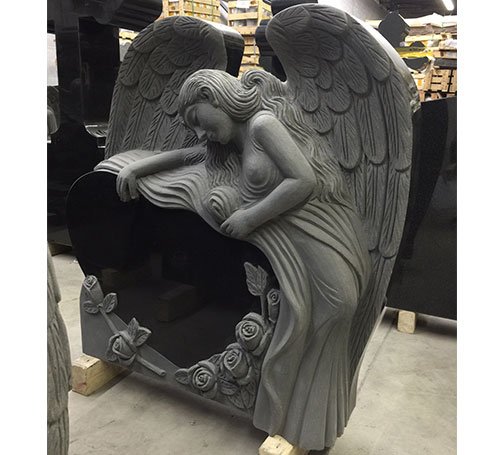
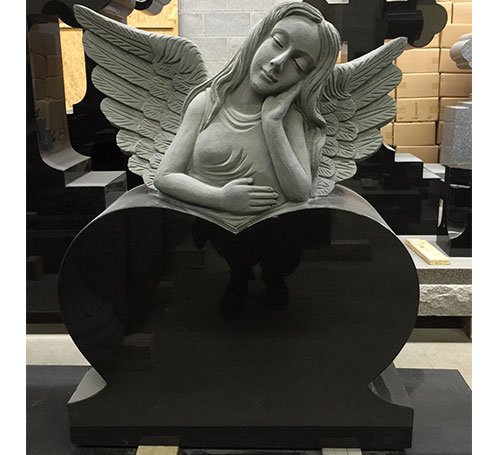
Angels pair naturally with a heart, carved roses or a cross, in grey or black granite, and can be set on any base. Our angel headstones page covers the styles, cemetery rules and pricing in full.
Statue monuments
Beyond angels, a full statue can form the memorial, such as a carved figure of the Virgin Mary set against the stone. Carved figures and symbols can be applied by several methods, which our guide to monument engraving methods explains. More carved figures are shown on our angel and statue monuments page.


Carved flowers: roses and lilies
What a carved flower means is not fixed. A rose is widely associated with love and beauty, and a lily with purity, innocence or resurrection, but these associations vary between families and traditions. Some families choose a flower for what it stands for. Others choose it because the person loved it. How the flower is cut matters as much as which one you choose.


- Rose. Widely associated with love and beauty. It can be cut at the shoulder or in a corner of the stone.
- Calla lily. Associated with purity, innocence or resurrection. Its long stem suits the side of an upright monument.
- Sandblasted, shape carved or relief carved. A sandblasted flower is cut flat into the face. Shape carving is still sandblasting, worked in layers so the petals take on soft, rounded shapes that stay close to the surface. Relief carving goes further and lifts the flower into true three dimensions, so it catches light and shadow. See how each engraving method is done.
Pagoda and Asian style monuments
For Chinese and other East Asian families we shape pagoda monuments with tiered rooflines, bamboo borders and engraved characters. Larger versions can commemorate more than one family member, and some are built as columbaria with niches for cremated remains.


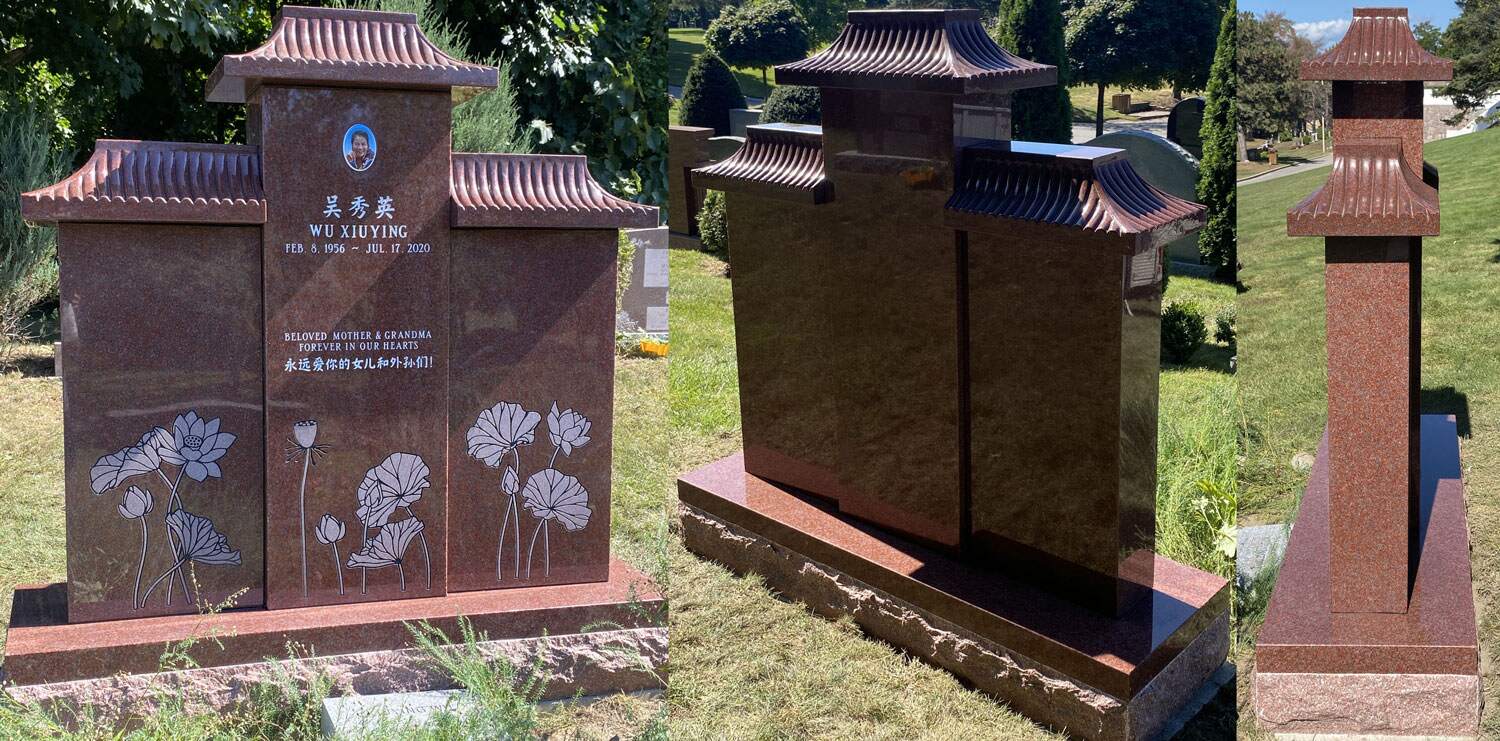
We engrave in both Traditional and Simplified Chinese and confirm the exact characters with each family. The same care carries into our Chinese urn engraving.
Teardrop, diamond and other unique shapes
Beyond the standard forms, the whole stone can be cut into almost any silhouette. These are where a memorial becomes personal.


Teardrops, diamonds, shells, guitars and children’s shapes such as a teddy bear are all possible, within what the stone, the budget and the cemetery allow.
Companion and family monuments
A companion monument is a wider stone made for two people. A family monument can carry several names, and some are built as columbaria with niches that hold cremated remains together.


Many of these shapes can be adapted to a companion width. See our custom monument service for family monuments and designs with multiple pieces.
Marker types: upright, flat, bevel, slant and bronze
“Headstone” and “grave marker” are often used to mean the same thing, but the marker format matters as much as the shape, and cemeteries frequently allow only one. Upright, flat, bevel and slant describe the profile of the stone; bronze describes the material, a cast plaque that is usually mounted on a granite base. Here is how the main grave marker types compare.
| Type | Profile | Visibility | Best for |
|---|---|---|---|
| Upright monument | Stands tall on a base | Seen from a distance | Full inscriptions, carved shapes and symbols |
| Flat marker | Flush with the ground | Read from directly above | Lawn level cemetery sections; simple, tidy memorials |
| Bevel marker | Low, raised slightly at the back | Read from close by | A middle ground between flat and slant |
| Slant marker | Angled front face | Read while standing | Easy reading without the height of a full upright |
| Bronze marker | Cast bronze plaque, usually on a granite base | Read from close by | Cemeteries that require bronze; lasting metal lettering |
Explore each format on its own page: flat markers, bevel and slant markers, and bronze markers. If you are deciding between an upright headstone and a flat marker, our guide to granite headstone vs flat marker compares the two in detail.
Faith and cultural traditions
Many of the memorials we design carry the marks of a specific faith or community. This is some of the work we are proudest of, because it asks for both craftsmanship and care.


- Chinese. Engraved characters, phoenix and dragon panels, bamboo borders and pagoda forms.
- Orthodox, Armenian and Celtic Christian. The three bar Slavic Orthodox cross, the Armenian khachkar style cross, and the ringed Celtic cross.
- Irish. Shamrocks, Celtic bands and harps.
- Jewish. The Star of David and Hebrew lettering.
- Persian language and Armenian language inscriptions, and other family emblems, carved to order.
How to choose a headstone type (and check the cemetery first)
Before you settle on a shape, confirm what the cemetery allows. Many cemeteries divide their grounds into sections: some permit full upright monuments, while others are lawn level and allow flat markers only. There are often limits on height, width and even colour. A design the cemetery cannot accept means delays, a redesign, or added cost, so this is the first call to make, not the last.
Once you know the format, the choice becomes easier:
- Want it seen from across the grounds? Choose an upright monument, and a serpentine or apex top for a traditional feel.
- In a lawn level section? A flat, bevel or bronze marker.
- Want something personal? A custom shape such as a heart, cross, book or teardrop, with a symbol that carries meaning for your family.
Cost varies with the shape, the granite and the amount of carving. Our monument cost guide for Ontario breaks down the ranges, and our GTA cemetery guide covers plot and installation details across the region. To start a design, see our upright headstones and monuments.
Frequently asked questions
What are the main types of headstones?
The main formats are upright monuments, flat markers, bevel markers, slant markers and bronze markers. Within the upright form, the top can be serpentine, half ogee, flat, oval or apex, and the whole stone can be cut into a custom shape such as a heart, cross, book or teardrop.
What is a serpentine top?
A serpentine top is a gentle S-curve along the upper edge of an upright headstone. It has a traditional look without being plain.
Can I order a custom shape like a heart, cross or book?
Yes. We design custom monuments, including hearts, crosses, books, teardrops, pagodas, angels and personal designs. Most monuments are engraved in Markham or Toronto. The main limit is what suits the stone and what the cemetery permits.
What is the difference between a headstone and a marker?
An upright headstone or monument stands tall on a base and is seen from a distance. A marker, whether flat, bevel, slant or bronze, sits low to the ground. Many cemeteries allow only one of these formats in a given section.
Do cemeteries limit which headstone types I can use?
Often, yes. Many cemeteries restrict height, width, colour and whether a section allows upright monuments or flat markers only. Always confirm the rules with the cemetery before you finalize a design.